
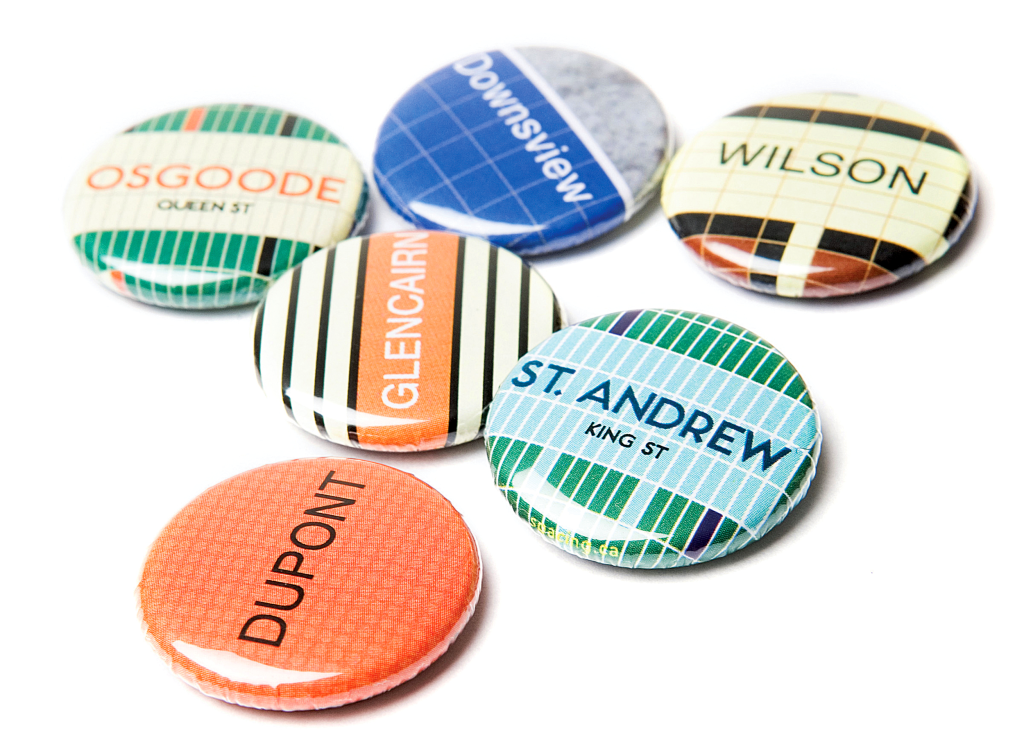
It’s been over 20 years since a chance encounter with a golf ball sale inspired a civic pride icon
This originally appeared in Spacing #69, 2024. It’s an edited conversation between Spacing staff and editors: Matthew Blackett (publisher), Shawn Micallef (senior editor), Dylan Reid (executive editor), John Lorinc (senior editor), Todd Harrison (former managing editor), Mike Bulko (retail director), and Glyn Bowerman (podcast producer)
Blackett: The idea for subway buttons came about on a night when we were coming home from a Toronto Psychogeographic Society walk.
Micallef: Yes, just an ad hoc group of people who met somewhere, generally on a Thursday night. We went for a long stroll for an hour or two, and just drifted through the city in an old-fashioned, psychogeographic kind of way. I think we all sort of got to learn about the city together. I certainly did, and then it sort of manifested in different ways… sometimes as stories, and this case, subway buttons.
Blackett: I remember getting on the subway with Dale [Duncan, Spacing’s first editor-in-chief] and we noticed an 8.5-by-11 printout selling golf balls with the TTC logo on it. They were for sale to employees. That was the spark of inspiration for all of it. I remember saying to Dale, “they should do a Dupont Station golf ball because they make orange golf balls [to see in the night] and with all the dimples in the golf balls, it would look like the station’s orange walls.” And then the conversation quickly turned to us making products. Obviously golfers were not our audience, but we were doing buttons already. We realized that you could do custom orders because digital printing was involved in making buttons, not mass-printing, which costs so much. And for the rest of the ride home the whole discussion was about the wall colours and digging into the design of the TTC.
Harrison: If I recall correctly, the early impetus of the subway buttons was the notion of selling products to celebrate civic pride, which were few and far between. When did David Miller first encounter the buttons?
Blackett: We had just started making them in December 2004. It was at a Grano dinner, one of those events that Robert Martella used to host up in midtown, on Yonge Street at his restaurant, gathering city-builders and civic leaders to take part in these salons. You would go around the room and everybody would say something on the evening’s theme or topic. When it came to me, I quickly turned promoter, threw a bag with the whole set of subway buttons towards Miller, landed on the table in front of him, talked about the buttons. It piqued Miller. Like, “what are these?!”
Micallef: It was a provocative challenge. The TTC didn’t know what to do with us or the buttons.
Blackett: That’s so true. I had a very Kafka-esque conversation with the TTC’s marketing department [before the buttons were launched]. I told them that I had an idea for a product. And they said, “the only way that you can do this is if we put out an RFP for that product.” I said, “but you don’t know what that product is. You can’t put out an RFP for a product you don’t know exists yet. I’m not going to tell you what it is to end up with somebody else winning the RFP and capitalizing on my idea, right?” And they said, “no, no, you start to bid on other stuff, and then we get to know you,” or something like that. And I’m like, “that’s not what this is.” So, I went out and did it on our own terms.
Micallef: Most of us were surprised at how popular the buttons became. We thought we would sell a few of them at our events, but then they just kept going and going and going. It kind of took a life of its own.
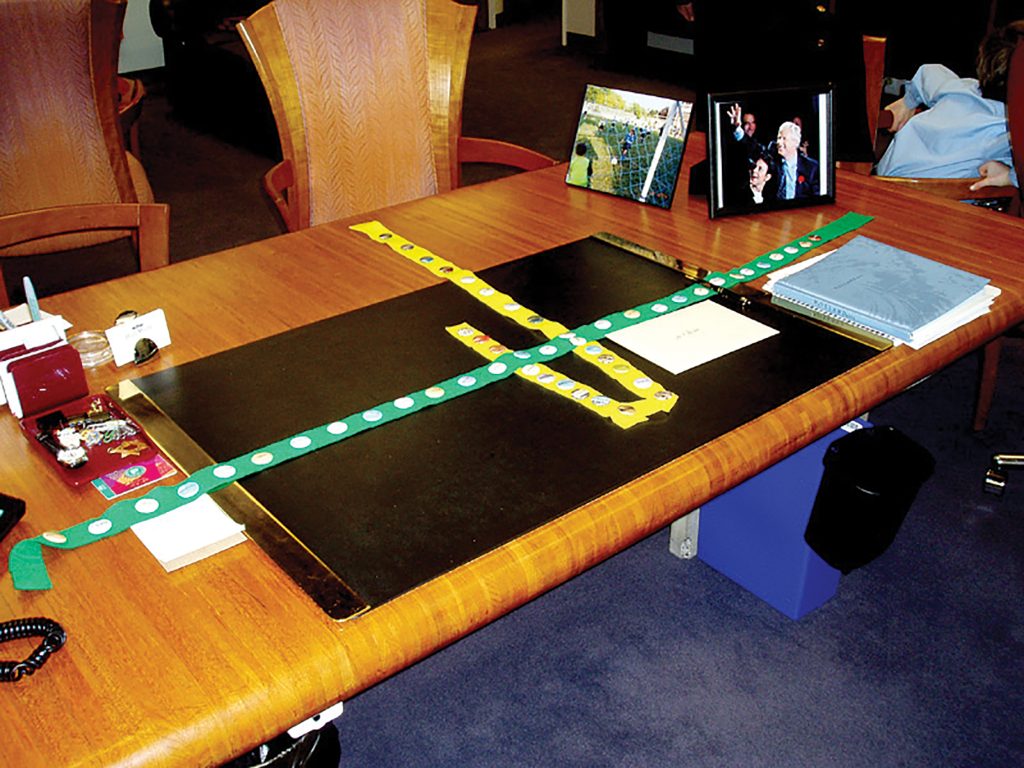
The Spacing subway buttons laid out on Mayor Miller’s desk, January 2005
Blackett: It became viral before we knew what “viral” was, right? People were doing their own fun things with the buttons. People making maps of them…. Maybe a month after I gave those buttons to Miller, Dale and I were at City Hall and saw Miller, who asked us to come up to his office. When we walked in, all the buttons were laid out on the mayor’s desk, pinned to felt strips in the shape and colour of the subway map that his son had made. Dale and I rode the high of seeing that for days. Luckily, I had a camera and took a photo of the scene (see photo above).
Micallef: That was when we knew we were on to something great. Did we ever get a cease and desist from it?
Blackett: No. There were a lot of cease-and-desist letters from the TTC going out to people who made parody subway maps and published them online. But Miller told me that he spoke to the TTC leadership at the time and said that it would be a PR disaster waiting to happen if they ordered fans of the TTC to stop making stuff. “Why would we discourage people that love the subway to not celebrate that?” was how he put it to me.
Obviously, we got a lot of media attention about the buttons. Miller was wearing them to events, and then the media were coming to us, and then it exploded all through the 2004 Christmas season. Actually, it was in January and February where it went really insane, so much so that I didn’t do any work over those months other than pack button orders [Blackett was a freelancer graphic designer at the time]. We made a lot of money, enough that the group agreed to pay me for my time, because I basically took all of January and February off from my work just to do the button fulfillment. It was so intense for six or seven weeks that as soon as sales dipped, I ran away for a week to London, England. I had to take a break from counting all of those fucking buttons.
Micallef: Going to London in February, a traditional place for Canadians to run.
Blackett: But on that trip, I was at a bar with a friend when a guy tapped me on the shoulder and asked if I was from Toronto. He pointed at my St. Clair West button I was wearing and said, “I have the Spadina button on my bag.” He went and got it and showed me! He got it from a family member who visited at Christmas. I couldn’t escape the buttons! The best thing about that trip though was I ended up at the London Transport museum gift shop, which became the inspiration for other products and the Spacing Store. I visited it again last spring and spent two hours in the shop drooling over their products.
Bulko: After my internship was over in the winter of 2009, I started managing button sales. It was a way for me to keep my foot in the door. It was a lot simpler back then, when it was just a handfuls of sets being shipped out. Combining those early-day sales and our decade of the store, we’ve sold over a million of the subway station buttons and magnets. They’re so popular with set designers.
Bowerman: Weren’t the buttons featured in that movie with the Harry Potter guy?
Blackett: Yes! Daniel Radcliffe, The F Word. His character wore the buttons for King and Dufferin on his jacket for the entire movie, I believe. That was great. And then there was one of those early parodies on YouTube of Queen West hipsters that someone did of a guy who was wearing 20 or 30 subway station buttons along the strap of his bag, riding a beat-up bike along Queen’s gallery strip. That was pretty good. And the buttons almost made it into The Handmaid’s Tale. A set designer came by the store and bought a whole bunch of stuff to decorate an apartment of a character in the show. I watched that season with an eagle’s eye just to spot buttons or fridge magnets, or a print. I was hoping for a magazine. Sadly, nothing.

Daniel Radcliffe’s character in the movie The F Word is wearing Toronto subway station buttons, made by Spacing, throughout the film.
Harrison: Neither the font or the tile designs were protected by a copyright, yeah?
Blackett: Right. The commissioned artwork in stations belongs to the artists, but we don’t do buttons of that stuff. As for the font, David Vereschagin had gone around and traced the letters on station walls. He scaled them down to make a proper display font called Commission, then changed it to Toronto Subway. It’s sold on Adobe Fonts now. He’s very integral to all of this.
Lorinc: The originator of that font design remains a mystery, correct?
Blackett: They’ve never been able to identify who created it. It must’ve been somebody in-house that did signage and stuff like that. Much like hand painters for signs… there were many people at the time that did that kind of work for the TTC.
Micallef: With Metrolinx not opening the Eglinton Crosstown anytime soon they are really thwarting a big revenue stream for all those new station buttons.
Blackett: Ha! But the whole subway button experience, and the success of it, gave us a template on how to do it with other products and projects. So we did it with the Pinko buttons. We did it with Metro Magnets. And the Rocket Wheel token holder.
Micallef: I mention this story sometimes when I’m just telling quickly the origin of how Spacing rolled into whatever it has become. And we never got rich. We never got rich. Well, I guess we went to England in February. We never got rich doing this, but we got to buy a couch for the office.
Lorinc: The Giambrone couch?
Blackett: Ha, no. Giambrone was a big supporter of the buttons, but that couch would’ve cost us a pretty penny at an auction.
Micallef: The blue dress of Toronto politics.